

Professor Pan Xiangbin's team from Fuwai Hospital has successfully completed the first‑in‑nation clinical implantations of the TriCap transcatheter tricuspid valve clip system.
Tricuspid valve intervention has long relied heavily on X-ray guidance. Physicians require dual guidance from DSA (Digital Subtraction Angiography) and ultrasound to deliver devices precisely to the target location. Both physicians and patients have had to make difficult trade-offs between "precise treatment" and "radiation exposure." This pain point is now being completely eliminated by original Chinese technology! Professor Pan Xiangbin's team pioneered the radiation-free percutaneous intervention technique (PAN Procedure), which disruptively relies solely on ultrasound guidance, completely freeing the procedure from dependence on radiation and contrast agents.
Recently, Professor Pan Xiangbin's team at Fuwai Hospital, Chinese Academy of Medical Sciences, successfully completed the first clinical implantations in China of the TriCap transcatheter tricuspid valve clipping system under pure ultrasound guidance. This innovative fusion of a pure ultrasound, radiation-free interventional system with a domestically produced tricuspid valve clipping system — "T-TEER with care and precision" — requires no radiation. It not only marks a key step forward in China's tricuspid valve interventional therapy, but also, with the disruptive advantage of a "green procedure," illuminates a safe, minimally invasive path for heart disease patients.

Patient History
The patient began experiencing intermittent chest tightness one month ago, accompanied by pitting edema of both lower extremities, without neck constriction, radiation, sweating, fatigue, dizziness, syncope or loss of consciousness, palpitations, nausea, vomiting, hemoptysis, cough, or sputum production. Symptoms have since occurred intermittently with the same nature and duration, mostly related to physical activity, emotional agitation, or heavy meals; no morning or nocturnal episodes. The patient is currently taking diuretics, edoxaban, statins, and other medications.
Admission diagnoses:1. Tricuspid regurgitation 2. Essential hypertension 3. Arrhythmia 4. Atrial fibrillation
Preoperative Transesophageal Echocardiography Assessment
Severe tricuspid regurgitation (4+, average vena contracta width: 13 mm), with the regurgitant orifice predominantly at the anteroseptal region, combined with central and posteroseptal involvement. Partial leaflet prolapse near the commissure of the anterior leaflet (prolapse height: 3.3 mm); malalignment of 2.2 mm between the leaflet tip near the central portion of the anterior leaflet and the septal leaflet. Septal leaflet tethering height 7 mm; tricuspid annulus dilation (mean annular diameter 44 mm). Pulmonary artery systolic pressure (PASP): 36 mmHg; inferior vena cava width approximately 21 mm.
 |
 |
 |
 |
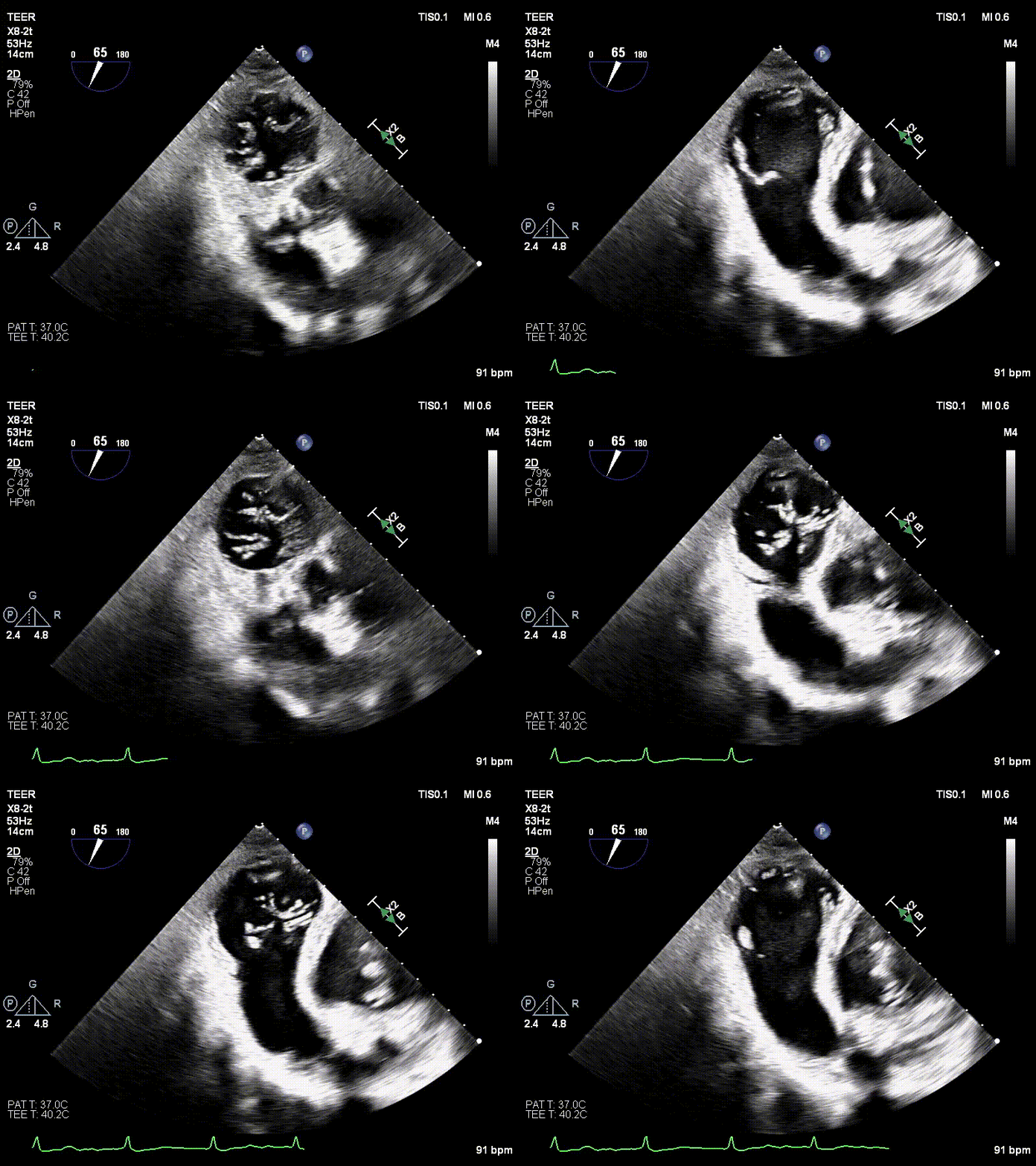
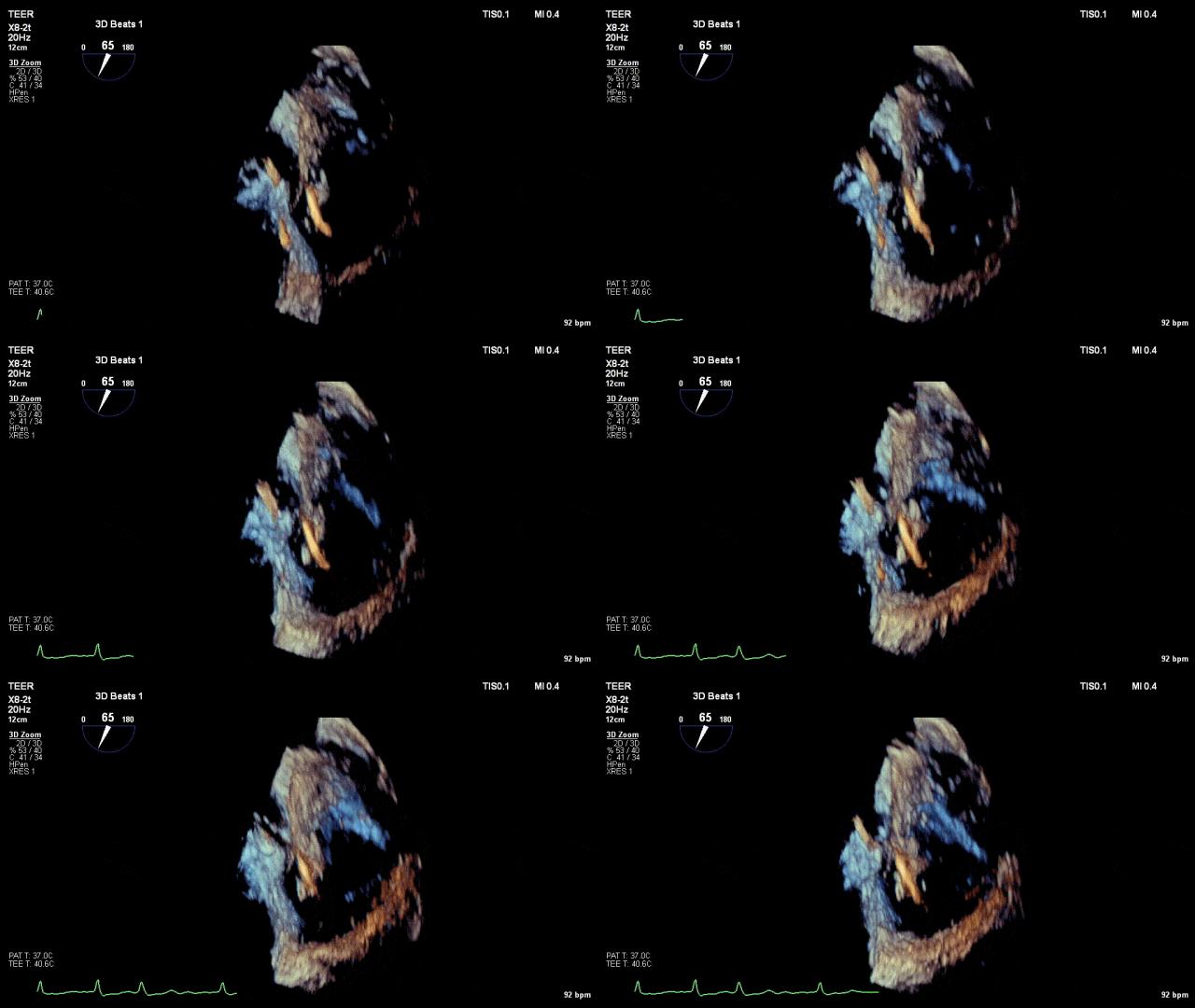
Surgical Strategy
Surgical Procedure
1. After general anesthesia, the femoral vein was punctured intraoperatively to establish access. Relying on extensive experience and the flexible steering capability of the TriCap controllable curve system, the operator precisely delivered the delivery system to the tricuspid valve target region guided solely by transesophageal echocardiography.
 |
 |
|
2.The device orientation was adjusted so that it aligned with the anteroseptal commissural region of the tricuspid valve. The clipping device was advanced across the tricuspid valve orifice into the right ventricle, then slowly retracted so that the leaflets entered between the clip arms.


3. Under ultrasound confirmation, the leaflets were captured. After confirming adequate and stable leaflet grasp, the clip was closed; immediate assessment showed significant reduction of regurgitation, with only residual central regurgitation. The first clip was then released.
 |
 |
 |
4. A second clip was subsequently advanced along the delivery system, aligned with the central portion of the anteroseptal region, parallel to the first clip. After clipping, only trace regurgitation remained. Transthoracic echocardiography showed tricuspid regurgitation of 1+ (trace).
 |
 |
 |
5. Peak tricuspid transvalvular gradient was 1 mmHg; mean transvalvular gradient was 0 mmHg.

Pre- and Postoperative Regurgitation Comparison
 |
 |
Postoperative ultrasound (right image) compared with preoperative ultrasound (left image): regurgitation was reduced from severe preoperatively to mild postoperatively.
 |
 |
Summary
For a long time, radiation injury has been an unavoidable shortcoming of interventional procedures. Many patients who could have been treated minimally invasively had no choice but conservative medical therapy or open surgery due to contraindications to radiation or contrast agents.
This integration of an innovative domestic tricuspid valve device with radiation-free percutaneous intervention technology — completing the first TriCap clinical implantations in China — has as its core goal the liberation of interventional procedures from the limitations of radiation. Using the real-time imaging clarity and localization precision of ultrasound to replace X-ray guidance protects the long-term occupational health of medical staff while providing patients with a safer minimally invasive treatment pathway.

Expert Profile
 |
|
Vice President of Fuwai Hospital, National Center for Cardiovascular Diseases, and Director of the Structural Heart Disease Center; Executive Director of the National Regional Medical Center, Fuwai Yunnan Cardiovascular Hospital, and Executive Director of Fuwai Hospital Shenzhen, Chinese Academy of Medical Sciences. Doctoral supervisor and chief physician. He is a dual doctoral supervisor in both cardiology and cardiac surgery, a national high-level talent program leading talent, and a national outstanding science and technology worker. He serves as Director of the National Health Commission's Structural Heart Disease Intervention Quality Control Center, and is an international senior fellow of the Society of Thoracic Surgeons (STS), the European Society of Cardiology (ESC), the Society for Cardiovascular Angiography and Interventions (SCAI), and the American College of Cardiology (ACC).He pioneered internationally an interventional technology system for cardiovascular diseases centered on pure ultrasound guidance, establishing a fully domestically owned Chinese solution integrating technology, devices, and equipment. Based on ultrasound guidance, he has invented 17 new techniques for treating different cardiovascular diseases and holds over 60 patents. He has been invited to perform live surgeries in dozens of countries including France, Germany, Canada, Russia, and Kenya. At the Chinese training base alone, he has trained 1,192 physicians from 32 countries. Twice dispatched by the state, he reported on China's original technologies at the Belt and Road Forum, where they played a significant role in "promoting people-to-people bonds," earning high praise from the Director-General of the World Health Organization. The new technology received the WHO Award for Science and Technology Innovation for its great contribution to "reducing disparities in medical service capacity among member states," and was pioneeringly selected by the United Nations as a globally promoted medical project, receiving UN funding and support from the global health system for its dissemination.

K-Clip® Transcatheter Tricuspid Annuloplasty System
1. Transvascular puncture access, minimal trauma, sheath outer diameter 18 Fr.
2. Simple operation, all steps completed on the atrial side, short learning curve.
3. All procedural steps are reversible before detachment, with controllable surgical outcomes. 4. Physiological annuloplasty technology, preserving native leaflets without damage.


